


On 8 September OpenAI announced they had found a solution to the Navier-Stokes problem, a $1m Millennium Prize Problem that has eluded mathematicians for over two centuries. This sparked an open letter from many luminaries in the mathematics community in which they criticised OpenAI’s actions as posing a “general threat to intellectual work”. The gist of their argument is that by shortcutting the discovery process, we lose much of the value of reaching a solution.
Technologies like AI are typically adopted on the promise of value creation. But while marketing and hype often amplify the immediate benefits, the value we risk losing is usually non-obvious and under-considered. We should hope that a new technology delivers net value, but we are often making a trade-off whether we recognise it or not. To better understand the trade-off, we can look at technology adoption through three lenses: epistemic, relational, and adaptive.
Epistemic: Losing our collective understanding
The open letter by Terence Tao and 24 other Fields Medal winners describes mathematics as a social process. Complicated problems, such as the Millennium Prize Problems, are rarely solved by a single mathematician or team. Progress is networked and highly collaborative. It is guided by social norms such as recognition of others’ work, formal processes such as peer review, and an emphasis on collective learning and the nurturing of future generations.
By announcing their solution in a press release, without formal write-up and peer review, the authors of the open letter argue that OpenAI has treated mathematical problem-solving simply as a race, driven by commercial incentives. They neglected the essential write-up, identification of new methods, and citation of previous work that allow ideas to be properly verified, understood, and integrated into the broader mathematical canon.
The letter warns against what is lost in broad-based understanding when we take shortcuts to solutions. The authors note the role of solutions to such problems as “landmarks and lighthouses against which one can measure an improved understanding of [the] landscape.” AI companies have gamed the process, subjecting the Millennium Prize Problems to Goodhart’s Law: When a measure becomes a target, it ceases to be a good measure.
Technology acts as a scaffold when it automates routine work to enable higher-level reasoning. It becomes destructive when it offloads reasoning itself. Few people today would argue that the calculator has been detrimental to our collective mathematical ability because it mostly offloads routine execution. Even when mathematicians use computers to solve advanced problems, they must still frame and parameterise the problem correctly. Generative AI tools threaten to offload both the execution and the thinking behind it.
If a device acts as a black box, delivering a target output without providing verifiable reasoning, we risk atrophying our understanding of the process, while also cutting off opportunities for intermediate discovery. As the authors of the open letter argue, the value is often less in the solution itself than in the collective knowledge gained and distributed while figuring it out, including the spin-off problems and new avenues of research that open up along the way.
Relational: Losing trust and human connection
I was staying with my dad in Sheffield not long after the open letter was published, and we talked about it over breakfast. He is a retired spinal injuries surgeon and expressed how grateful he was to go through training when so much was still done manually, such as measuring a patient’s blood pressure using a sphygmomanometer and a stethoscope rather than a digital blood pressure monitor, or carrying out detailed clinical examinations rather than requesting a scan.
When a clinician manually inflates a cuff or presses an abdomen, they encounter tactile cues in muscle guarding, skin temperature, and breathing changes, which can provide critical diagnostic and emotional information about the patient’s underlying state that a digital readout or scan would miss. While medical technologies serve to reduce human error and variance, they also come to mediate the relationship between doctor and patient, reducing opportunities for doctors to pick up on subtle sensory information.
In my dad’s own words, “The issue is the creation of a machine barrier between the practitioner and the patient. I believe that physical contact is an important part of building trust and confidence in the process. I am sure some people believe that being monitored by a machine and diagnosed by AI is the bee’s knees, but I would rather be treated by someone I felt had a depth of knowledge and a human touch.” A wise man.
Ted Kaptchuk, Professor of Medicine at Harvard Medical School, argues similarly that the therapeutic encounter between clinician and patient plays a major role in health outcomes. He points out that even when patients know they are taking a placebo, a clinician’s empathy, active listening, and physical presence can still drive meaningful symptom relief. The “placebo effect” is, in fact, the positive effect of all the non-interventionist aspects of a patient’s experience in healthcare settings.
What is true in healthcare settings holds across many different domains in which the intersubjective bonds of trust and empathy between people can matter as much as targeted results. When we optimise for friction-free delivery, placing a machine barrier between doctor and patient, teacher and student, or civil servant and citizen, we risk losing the untargeted, indirect value that arises through presence and meaningful human connection.
Adaptive: Losing our agency and resilience
There is no shortage of news articles about people getting lost on mountains and needing to be rescued due to their over-reliance on technology and lack of practical know-how. While modern navigation tools offer unprecedented accuracy, over-reliance can degrade situational awareness. When hikers lack experience, they trust their devices more than they trust their own senses, treating them as infallible guides rather than useful tools.1
Experienced hikers naturally monitor their environment for subtle hazard cues, such as changing cloud cover, fading sunlight, steeper terrain, or diminishing trail quality. They recognise the micro-level, real-time contextual information that is critical for staying safe, and isn’t picked up by a digital map or weather app. Active engagement with their surroundings enables them to adapt when conditions change. By contrast, the false sense of order conveyed by smartphone apps can blind inexperienced hikers to emerging risks and lead them into danger.
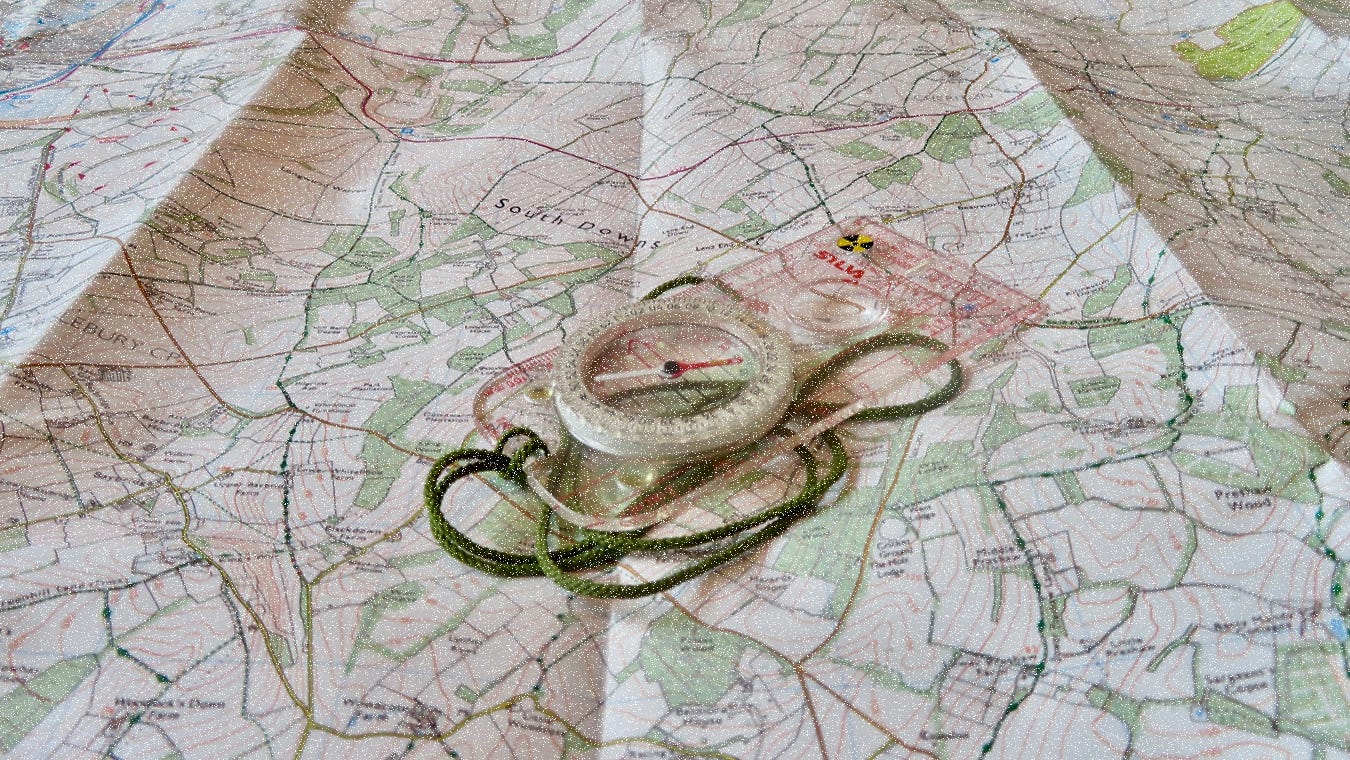
This difference reflects a broader pattern described by philosopher Albert Borgmann in Technology and the Character of Contemporary Life. Borgmann contrasts “focal things”, which require manual skill, spatial awareness, and physical movement, with “devices”, which deliver results instantly and demand little of us. Using a map and compass requires conscious and embodied engagement as we look around and locate ourselves. Using a smartphone encourages us to offload our spatial awareness, following the dot on a screen.
By letting a device mediate engagement with our surroundings, we bypass the need to build our own mental map. If we lose signal or run out of battery when out in the wilderness, the loss of digital navigation is compounded by depleted spatial memory. Ultimately, reliance on a smartphone instils false confidence through a simplified representation of the world, and can leave us without the situational awareness to change course when things go wrong.
Technology can undoubtedly be useful when problems are trivial and easily detected, such as minor course corrections in good weather and with a good signal. Fragility arises when we delegate our judgement and forgo full engagement with our environment. Unrecognised reliance on technology can expose us to extreme risk in edge cases, when local conditions require us to adapt, and yet we defer to the coarse-grained information provided by our devices. When we use technology as a shortcut for experience, we gain convenience, but we lose resilience.
Evaluating the adoption trade-off
With the rise of AI, it is more important than ever to consider what we’re at risk of losing when we rush to adopt new technologies. At scale, we risk eroding the broad-based understanding, human connection, and adaptive resilience upon which true progress depends. These three lenses highlight several ways the adoption of new technologies can lead to maladaptive outcomes, undermining progress toward complex goals and diminishing human agency.
When we use technology to shortcut a journey and deliver us directly to our destination, we mistake the target for the true goal. As Terence Tao and the other Fields Medalists observed, the solution to an open mathematical problem is only a proxy for broad-based understanding. Similarly, a data-driven diagnosis is often only a proxy for restoring a patient's health, and a route on a screen is only a proxy for a safe and enjoyable hike. When the true goal is complex, it resists reduction.
When we rely on technology, we devalue the importance of tacit knowledge. While technologies draw on explicit knowledge to automate processes, human experience also produces tacit knowledge. Tacit knowledge is our intuitive, context-based understanding of the world, captured by Michael Polanyi’s maxim, “We know more than we can tell.” Tacit knowledge enables a mathematician to sense a fruitful detour in research, a senior clinician to read subtle cues through touch, or a hiker to navigate in poor conditions.
When we place technology between ourselves and our experience of the world and each other, we change the nature of our engagement. We treat presence, physical and mental effort, and the work of human collaboration as inefficiencies to be eliminated. Yet it is precisely through this unmediated engagement that we cultivate shared canonical knowledge, intersubjective trust, and the immediate situational awareness required to adapt when circumstances change.
To navigate the adoption of new technologies without sacrificing our essential human agency, we can ask three questions aligned with each lens:
Epistemic: Does this technology offload routine execution, or does it bypass our ability to reason and build understanding? Technology is constructive when it offloads routine work, but damaging when it replaces the cognitive understanding required to reason through problems.
Relational: Does this technology facilitate and expand human connection, or does it place a barrier between people that reduces empathy and trust? Technology is net-negative when the loss of empathy, trust, and subtle cues that arise through human connection outweighs the efficiency gains of friction-free delivery.
Adaptive: Does the use of technology enhance our agency, or does it trade situational awareness for fragile convenience? Technology results in fragility when it erodes our active engagement with the world, creates a false sense of security, and leaves us without the slack resources needed to adapt when conditions change.
Sources
Avila, A. et al. (2026) ‘Open Letter: A Severe Misalignment of AI in Mathematics’, 11 September. Available at: https://doi.org/10.5281/zenodo.22737750.
Borgmann, A. (1984) Technology and the Character of Contemporary Life: A Philosophical Inquiry. Chicago, IL: University of Chicago Press. Available at: https://press.uchicago.edu/ucp/books/book/chicago/T/bo23186480.html.
OpenAI (2026) On the Navier–Stokes Millennium Prize Problem, OpenAI. Available at: https://openai.com/index/navier-stokes-solution/.
NCCIH (2015) What Is a Placebo? Q and A with Ted Kaptchuk. Watch:
While I haven’t drawn from a particular source, this metaphor is influenced by Dave Snowden’s frequent use of mountain walking to illustrate points related to adaptive capacity and resilience in complex environments. See: https://thecynefin.co/our-thinking/.