


“Creativity is just connecting things. When you ask creative people how they did something, they feel a little guilty because they didn’t really do it, they just saw something. It seemed obvious to them after a while. That’s because they were able to connect experiences they’ve had and synthesize new things. And the reason they were able to do that was that they’ve had more experiences or they’ve thought more about their experiences than other people.”
- Steve Jobs
I know it’s a cliche to start an article about creativity and innovation with a quote from Steve Jobs, but he makes the point well and his intuition aligns with the evidence. Creativity is just connecting things. It’s mostly about exposing yourself to lots of existing ideas, absorbing and combining those influences, and having a go through trial-and-error tinkering. Last week’s essay provided a close-up case study of the revolutionary potential of combinatorial creativity. This week’s focuses on four simple behaviours that unlock creative potential.
Engage widely with people and culture
Creative people seek out new experiences. They read a lot. They read widely. They engage with different forms of culture. They have a diverse network. They chase new connections. Exposing oneself to diverse ideas, people, and cultures is rooted in openness to experience, which research identifies as the single strongest personality predictor of creative achievement. By engaging widely with people and culture, you can feed fresh perspectives into your core creative work.
When this broad exploration is combined with domain mastery, it forms a “T-shaped” knowledge profile. This describes an individual who possesses deep expertise and experience in one domain (the vertical stem of the “T”), coupled with a wide breadth of knowledge and curiosity across many different domains (the horizontal crossbar of the “T”). The term was popularised by IDEO’s Tim Brown, and reflects research by Dean Keith Simonton showing that leading scientists, writers, artists, and politicians usually display curiosity outside their primary fields.
Deep expertise in one domain can result in a high degree of mental rigidity, where the mind defaults to certain categories and explanations for things. Exposure to different cultures or disciplines forces the brain to re-evaluate its existing frameworks, particularly when those cultures or disciplines understand the world in an inherently different way. As anyone who has spent enough time immersed in a different culture will attest, it is only when you step outside your own culture that you truly begin to sense the extent to which you have been subconsciously conditioned by it.
Living abroad or engaging deeply in unfamiliar cultural environments significantly improves our capacity to identify hidden patterns and forge links between seemingly distant concepts. Historically, periods of cultural influx and immigration have often preceded major surges in creative achievement, precisely because the collision of distinct worldviews disrupts conventional thinking and breeds novel perspectives. Abraham Maslow described moving to New York in the 1930s amid a renaissance in psychology, sparked by the mass emigration of Jewish and European psychoanalysts, psychologists, and anthropologists.
Ultimately, creativity is a primarily social phenomenon, relying on the cross-pollination of ideas between people and cultures. People who maintain broad social networks generate more innovative outcomes than those who only engage with similar peers. In network theory, a dynamic known as the “strength of weak ties” describes how we mostly exist in social clusters where we each know the same people and the same information, and it is our casual acquaintances (weak ties) who act as critical bridges to new environments, information, and ideas.
Capture thoughts and observations
During the 16th and 17th centuries no aspiring intellectual would dream of venturing outside without a book in hand to take notes of their observations. While the practice of “commonplacing” has its roots in ancient Greece and Rome, the trend took off when the 16th century influencer, Erasmus, began instructing his students on how to keep a notebook for gathering quotes, metaphors, and moral lessons. A century later, John Locke pioneered a popular new indexing technique for commonplace notebooks, delighting 17th century stationery obsessives.
As told by Steven Johnson, Charles Darwin was a commonplacer, making meticulous notes during his travels in the 19th century. In the pages of his notebook, he sketched flora and fauna, carefully noted his observations, and jotted down speculative ideas. He would regularly review past notes in the light of present thoughts. It was while on a boat in the middle of the Indian Ocean that a sudden idea prompted him to revisit his five-month-old Galápagos observations, opening up a new line of thinking that would become the theory of natural selection.
More recent commonplacers include the writers Joan Didion and Marina Keegan. Didion reflected in her essay, “On Keeping a Notebook”, that it was not to log her activities, or to make notes about other people, but to “remember what it was to be me”. Marina Keegan, who found fame after her death in 2012 at the age of just twenty-two, kept a notebook called “Interesting stuff”, that she described as containing “everything from descriptions of a waiter’s hand gestures, to my cab driver’s eyes, to strange things that happen to me or a way to phrase something.”
Capturing and documenting ideas, whether as notes, sketches, diagrams, or formulas, serves as a critical bridge between fleeting mental sparks and sustained creative work. Because partial insights and slow hunches are easily lost to daily distractions, maintaining a habit of recording thoughts, sights, and murky intuitions preserves them for future inspiration. Apps such as DEVONthink, Notion, and Obsidian provide a digital alternative to commonplacing, allowing you to organise, search, and link your thoughts in a personal knowledge base. I use Obsidian because it’s free, flexible, and uses an open format that prioritises privacy and ownership.
Play around with ideas
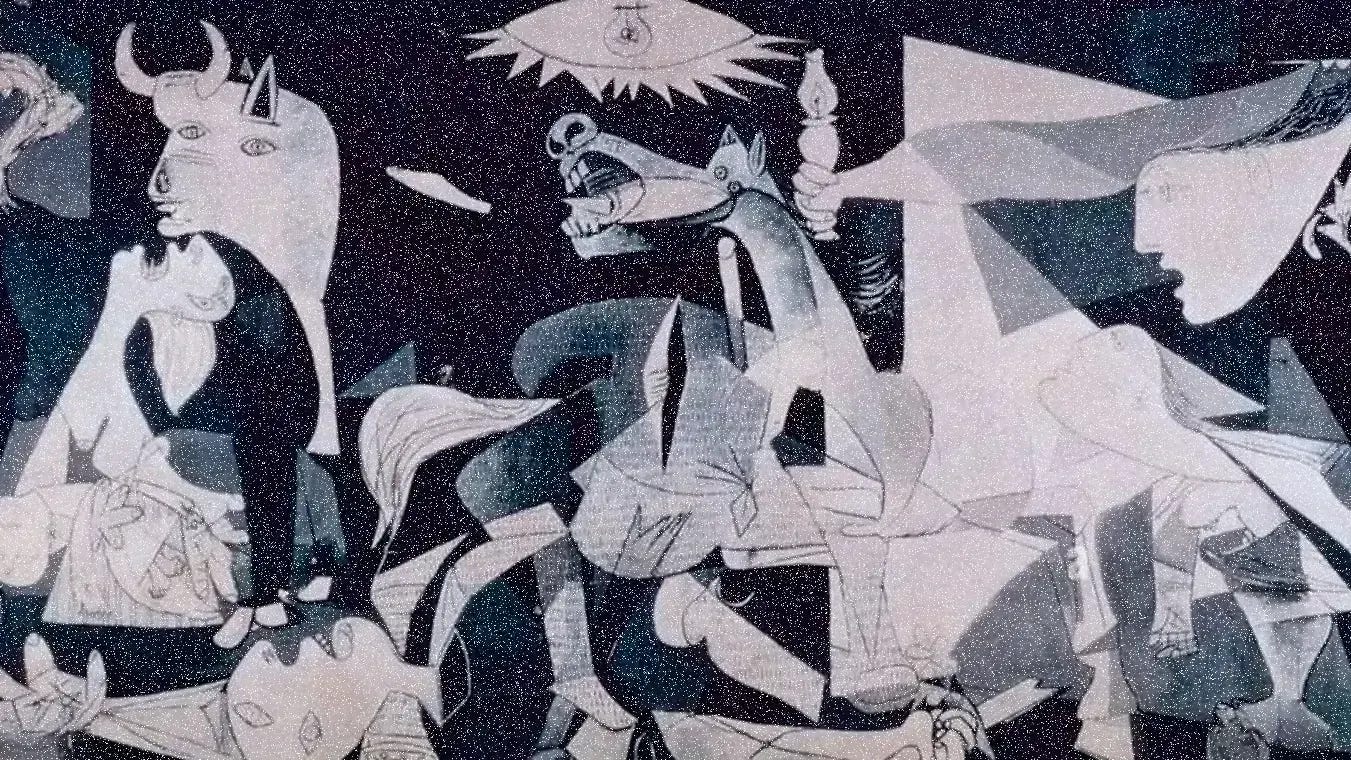
“A painting is not thought out and settled in advance. While it is being done, it changes as one’s thoughts change. And when it’s finished, it goes on changing, according to the state of mind of whoever is looking at it.”
- Pablo Picasso
We create things as embodied beings participating in a physical and material world. Playing with ideas occurs through activities such as drafting, sketching, modelling, and prototyping, where the final form is discovered rather than predetermined. When an individual plays with tools or materials, those objects offer affordances—latent possibilities that cannot be predicted through abstract thought alone. As a painter doesn’t know every brushstroke before they begin to paint, a writer rarely anticipates the full shape of a thought until they begin to write.
When Pablo Picasso painted his masterpiece, Guernica, his process involved 45 preliminary sketches full of false starts, discarded variations, and structural revisions. Without a preconceived end, each false start revealed new possibilities. This emergence of hidden affordances throughout the artistic process leads to a dialogue between the creator and the medium. Instead of starting with a predefined goal and mentally preconceiving the output, tinkering allows the creator to embrace ambiguity and uncover new meanings and functions along the journey.
The results of two separate experiments in the creative arts and industrial design reinforce this picture. In a landmark study at the School of the Art Institute of Chicago (SAIC), Mihaly Csikszentmihalyi and Jacob Getzels demonstrated that actively seeking discovery at the outset of a creative project determined the originality of the output. The most original outcomes arose when students experimented with subject matter and varied compositions, allowing the initial marks on canvas to suggest subsequent steps. Conversely, those who set out with a clear idea of what they wanted to draw or convey produced significantly less creative outputs.
These findings echo those of psychologist Bryan Lawson, whose experiments in design contrasted analytical and generative strategies. Those who applied analytical strategies solved puzzles by systematically studying the problem to discover a fundamental rule that would lead to the best solution. By contrast, those who applied generative strategies immediately started proposing and evaluating different potential designs, recognising that design problems rarely possess a single, predefined optimal solution—much like creating an original work of art.
In “Wired to Create”, Scott Barry Kauffman and Carolyn Gregoire emphasise the importance of integrating both imaginative and rational modes of thought. They describe the way in which creativity involves toggling between spontaneous, exploratory generation and deliberate, reflective evaluation. By maintaining a spirit of play, interspersed with bouts of rigorous critical reflection, creators of all stripes—whether artists, writers, designers, inventors, or scientists—can gradually transform a raw hunch into a finished work.
Make time to do nothing
Rest assured of the importance of being idle. Creativity requires periods of unstructured idleness where the conscious mind relaxes its grip. On a neurobiological level, research shows that leisure time lets the brain’s executive function wind down, enabling imagination to take over. This shift allows the mind to shuffle subconscious fragments and forge novel connections beneath conscious awareness. Give your mind permission to wander, and let your best ideas surface on their own.
Low-key physical activities provide ideal conditions for this subconscious percolation, separating us from the demands of work and home, and quietening mental preoccupations. According market research for a showerhead supplier, 72% of people report experiencing fresh insights in the shower! Going for a walk is another well-evidenced catalyst for creativity, triggering physiological shifts that place the brain in a fertile associative state. History is replete with “thinker-walkers”, including Charles Darwin, as well as Virginia Woolf and Friedrich Nietzsche. On this point, I strongly advise adopting a dog.
Idle time is not a mark of laziness or wasted effort, but an indispensable stage in the cycle of creative work. (Sadly, this very real insight is lost on employers, who can track your time staring at a screen but cannot measure the productivity gains of having a little lie down in the afternoon.) Creativity requires balancing protracted periods of preparation and play, with dedicated periods of idleness, giving our unconscious mind the necessary space to connect lingering hunches and serve up some inspiration.
A final note on AI and creativity
LLMs clearly have a role to play in fostering combinatorial creativity. I personally find that prompts such as, “How does idea A relate to idea B?”, or “Tell me about concept X through the lens of concept Y”, can aid my thinking and provide inspiration, with the caveats of checking sources and maintaining a critical stance towards outputs. But despite the hype, LLMs have no access to real-world context and rely primarily on inductive pattern-matching across datasets, making them good for some things and not others. These constraints may prove to be fundamental limitations.
Andrea Roli, Johannes Jaeger, and Stuart Kauffman argue that meaning-making plays a critical role in human creativity, and that this is unique to biological life. We can recognise that the meaning of a word or use of an object is dependent on context, rather than being an intrinsic property of the word or object itself. We can spot affordances and improvise or repurpose everyday objects in a way that artificial intelligence cannot. Roli and colleagues conclude that radical creativity requires organismic agency—a drive to survive and navigate the physical world that is beyond computation. If they are right, we may yet keep our creative edge.
Sources
Cross, N. (1982) ‘Designerly ways of knowing’, Design Studies, 3(4), pp. 221–227. Available at: https://doi.org/10.1016/0142-694X(82)90040-0.
Csikszentmihalyi, M. (2014) The Systems Model of Creativity: The Collected Works of Mihaly Csikszentmihalyi. Dordrecht: Springer Netherlands. Available at: https://doi.org/10.1007/978-94-017-9085-7.
Johnson, S. (2010) Where Good Ideas Come From: The Natural History of Innovation. London: Penguin Books. Available at: https://www.penguin.co.uk/books/56300/where-good-ideas-come-from-by-johnson-steven/9780141964591.
Kaufman, S.B. (2022) Transcend: The New Science of Self-Actualization. London, UK: Sheldon Press. Available at: https://www.sheldonpress.co.uk/titles/scott-barry-kaufman/transcend/9781399805582/.
Kaufman, S.B. and Gregoire, C. (2015) Wired to Create. London, UK: Vermilion. Available at: https://www.penguin.co.uk/books/433236/wired-to-create-by-dr-scott-barry-kaufman-and-carolyn-gregoire/9781785040641.
Parrish, S. (no date) ‘Joan Didion on Keeping a Notebook’. Farnam Street. Available at: https://fs.blog/keeping-a-notebook/.
Parrish, S. (no date) ‘Steve Jobs on Creativity’. Farnam Street. Available at: https://fs.blog/steve-jobs-on-creativity/.
Roli, A., Jaeger, J. and Kauffman, S.A. (2022) ‘How Organisms Come to Know the World: Fundamental Limits on Artificial General Intelligence’, Frontiers in Ecology and Evolution, 9. Available at: https://doi.org/10.3389/fevo.2021.806283.
Simonton, D.K. (1999) Origins of Genius: Darwinian Perspectives on Creativity. Oxford University PressNew York, NY. Available at: https://doi.org/10.1093/oso/9780195128796.001.0001.
Watts, D.J. (2004) Six Degrees: The Science of a Connected Age. New York , NY: Norton. Available at: https://wwnorton.com/books/9780393325423.